
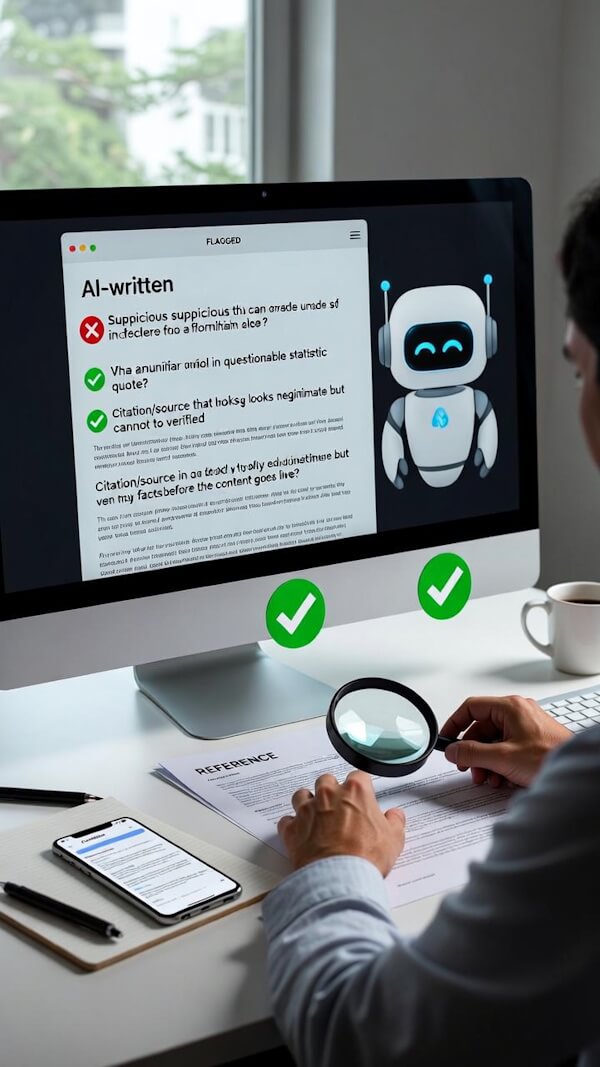
Fact check AI content before publishing it, because generative AI can produce a polished blog post in minutes, along with a fake statistic, an invented quote, or a source that disappears the moment you search for it. Fun little surprise.
That’s why every AI-assisted draft needs a human review before it reaches your blog, newsletter, social captions, content channels, or AI video script. Publishing false information can weaken reader trust and hurt your brand’s credibility.
A clear review process helps protect your audience, your reputation, and the quality of your content before anything goes live.
Key Takeaways
- Treat all AI-generated content as an unverified first draft, even when it sounds confident.
- Check facts one claim at a time, starting with numbers, quotes, names, dates, and links.
- Use original sources whenever possible, not a pile of blogs repeating each other.
- Remove any claim you cannot verify quickly and clearly.
- Review AI visuals and video scripts with the same care as written content.
How to Fact Check AI Content Without Guessing
The biggest issue with AI writing is not bad grammar. You can fix grammar in 30 seconds.
The bigger problem is that generative AI and large language models can sound certain while being wrong. They may combine real details with invented ones. They may cite a real publication that never made the draft’s claim.
Researchers call these fluent errors AI hallucinations. A review of AI factuality research shows why factual review still requires human oversight, especially when content affects academic integrity, professional decisions, or public understanding.
Begin this part of the research process by separating the draft into two buckets:
- Low-risk copy includes transitions, general explanations, headlines, and common-sense advice.
- High-risk claims include statistics, laws, prices, medical advice, product features, historical details, customer results, and quotes.
High-risk claims get checked first. Every time. Use lateral reading when a claim matters. Leave the original draft or cited page open, then open independent tabs, and compare the claim across authoritative sources.
An automated fact-checker can help screen claims quickly, but it cannot replace judgment. AI detectors assess writing patterns or likely machine authorship, not factual accuracy, and they can produce false positives.
A sentence like “Short videos help brands get noticed” is broad and needs context. A sentence like “Short videos raise conversions by 87 percent” needs a source, a date, a study, and a reason to exist in your post.
Publishing an unsupported claim can spread misinformation and weaken reader trust. Check the evidence and the source quality before it reaches the page.
No source? No stat.
A sentence that sounds polished is not proof. AI is good at smooth wording, not automatic truth.
Pull Every Claim Into The Light to Fact Check AI Content
Do not read a draft of AI-generated content like a regular blog post. Read it line by line, like you are looking for loose floorboards. Highlight every proper name, number, date, quote, study, company claim, and external link. This is fractionation, splitting a broad draft into smaller claims you can verify.
This claim-by-claim review catches the sneaky details in an AI draft. Use lateral reading too: open a new tab and compare each claim with independent sources instead of trusting the original page.
Here is what needs a closer look:
- A number, percentage, dollar amount, or date needs an original report, official documentation, or other reliable sources.
- A quote needs an exact source, not a vague reference to an interview or article.
- A product feature needs confirmation from the company that sells it.
- A legal, health, financial, or compliance claim needs a current authoritative source.
- A customer result needs proof from the real customer and honest context, so you don’t pass along fake information.
Take this example:
“Businesses using AI video tools save 10 hours per week.”
Maybe that is true for one business. Maybe it came from a survey. That is how AI hallucinations happen: a plausible sentence gets generated without evidence.
Find the original study. Check who ran it, how many people took part, and when it happened. Compare the finding with another independent source. If you cannot verify it, soften or remove the claim.
“AI video tools can reduce repetitive production tasks, especially when you reuse a clear script and visual plan.”
That version makes a reasonable claim without pretending you have a universal number.
Fact Check AI Content: Check Sources, Not Just Citations
A citation can look official and still be nonsense. Generative AI may fabricate article titles, author names, publication dates, and URLs. AI hallucinations can also attach a real publication to the wrong claim.
Source citations are not proof on their own. Click the link, then use lateral reading to check it elsewhere.
Check these four things:
- Does the source exist? Search the exact title in Google, Google Scholar, a library database, or the publisher’s site.
- Does it say what the AI claims? Read the relevant section, then compare the claim with independent sources through lateral reading. Do not trust the summary.
- Is it current enough? A 2021 tool review may be ancient history for AI software in 2026.
- Is it close to the original? Trustworthy sources include government reports, primary research, official documentation, direct interviews, and original transcripts. These beat a blog quoting another blog.
Be extra careful with quote marks. Search the exact phrase in quotation marks. Then find the original article, transcript, speech, book, or video where it appeared.
If you cannot trace it, do not publish it.
That rule also applies to testimonials. Do not let AI turn “I felt more confident posting” into “This doubled my sales.” Clear progress is persuasive. Inflated results make people squint.
When a customer shares a measurable result, verify the time period, baseline, measurement method, and other variables that changed. A truthful result has texture. It does not read like a miracle cure in a bottle.
Verify Customer Claims Before They Become Marketing Copy
AI is useful for turning customer interviews into testimonials, case studies, captions, and short video scripts. It can find patterns fast.
When reviewing a customer outcome, use lateral reading. Compare the AI summary with interview notes, customer-approved wording, analytics, and the relevant time period. Don’t rely on a polished testimonial alone.
Good proof often looks like this:
- A business owner stopped losing hours to design tasks every week.
- A marketer posted more consistently because the approval process got easier.
- A coach had a clearer message for a launch after turning a long article into a simple visual story.
Those claims are believable because they are concrete. They also do not promise that every customer will get the same outcome. Do not let AI write guarantees that your real-world proof cannot support. “Get more leads fast” may sound punchy. It is also a claim you need to back up.
“Create clearer content that helps the right people understand your offer” is more honest, and honestly, more useful.
Review AI Images And Video Scripts Too
Written facts aren’t the only facts that can go wrong. The same review standard applies to AI-generated visuals used in blog posts, videos, ads, and social content.
Generative AI can create visuals and scripts, but AI-generated content can still contain factual errors in a visual format. An AI video script can also sneak in a false claim if it pulls from the original blog draft.
Visual review should also catch common AI image fails, including distorted hands, unreadable text, incorrect product details, altered logos, and backgrounds that create a false impression.
Before publishing, check the visual story against verified claims for factual accuracy:
- Does the image show a real product feature accurately and serve its intended role in content creation?
- Does the script match the article’s verified claims?
- Are charts, maps, dates, and labels correct?
- Could an illustrative scene be mistaken for documentary evidence of an event or person?
For a broader pre-publish review covering permissions, disclosures, copyright, and approval, use this AI brand safety checklist for generated visuals.
A misleading chart, caption, scene, or voiceover can spread misinformation, even when the surrounding article is accurate.
If a visual is illustrative, make that clear in your production process. Don’t use AI visuals to fabricate customer results, before-and-after proof, locations, or real-world events.
For any graphic that communicates a claim, offer, chart, or instruction, write accurate alt text for marketing graphics that matches the finished visual.
Once your blog post is solid, you can turn blog posts into short videos without carrying bad information into five new pieces of content. Keep verified source notes with every derivative asset. One wrong claim multiplies fast, but a strong fact-check protects every version.
Use A Simple Pre-Publish Routine to Fact Check AI Content
When reviewing AI-generated content, you do not need a three-hour research session for every 700-word post. A repeatable routine is enough.
A light review may take 15 to 30 minutes when it has only a few checkable claims. A research-heavy post with statistics, medical guidance, legal information, or customer data may take 1 to 2 hours or more. The time depends on the number and risk level of the claims, not just the word count.
Treat this as a reusable editorial check for generative AI. Use these fact-checking techniques in order. First, read the draft once for the main message. Does it answer the reader’s question? Is the advice clear?
Next, highlight high-risk claims. Check the facts against original or authoritative sources. Replace vague claims with details you can prove.
Then open every link. Confirm it works, supports the sentence around it, and does not send readers to a sketchy page full of pop-ups and nonsense. Use lateral reading when a source matters by comparing it with independent references.
If a claim or link seems questionable, check it from another angle with lateral reading. Look for consistent evidence before keeping it in the draft. Automated tools, including AI detectors, can flag unusual wording or organize a review, but they cannot establish truth.
Finally, read the article out loud. This catches awkward AI phrasing, repeated points, and sentences that sound more certain than the evidence allows.
Keep a short source file for bigger posts. Save the source citations, URLs, reports, screenshots, interview notes, and approval details. Future-you will be grateful when someone asks, “Where did this number come from?”
This routine supports factual accuracy while protecting clarity, usefulness, trust, and content quality.
Fact Check AI Content Final Thoughts
AI can speed up your content process. It cannot carry your reputation or responsibility for your brand integrity.
The safest habit is simple: verify every important claim before publication. Check the claims, check the sources, keep customer proof truthful, and cut anything you can’t support.
Fact Check AI Content FAQs
How accurate is AI-generated content?
It varies. Generative AI can produce useful drafts, but it can also invent facts, citations, quotes, dates, and statistics. Accuracy depends on the topic, prompt, model, and human review after drafting.
What should I check first when I fact check AI content?
Start with numbers, quotes, names, dates, legal claims, health claims, product details, customer results, and citations. These claims are most likely to damage trust when they’re wrong.
Can I use AI-generated testimonials?
You can use AI to organize or edit a real customer interview. Don’t use it to invent customer stories, inflate results, or create fake quotes. Keep the customer’s meaning intact, and confirm the final wording with them.
Should I use AI detectors before publishing?
These tools offer a rough authorship signal, but they aren’t evidence of factual accuracy. They can create false positives and shouldn’t be confused with plagiarism detection or text detection. A claim-by-claim review is more useful than focusing on whether the writing sounds human.

As a Visual Digital Marketing Specialist for New Horizons 123, Julie works to grow small businesses, increasing their online visibility by leveraging the latest in internet and video technologies. She specializes in creative camera-less animated video production, custom images, content writing, and SlideShare presentations. Julie also manages content, blog management, email marketing, marketing automation, and social media for her clients.



0 Comments