
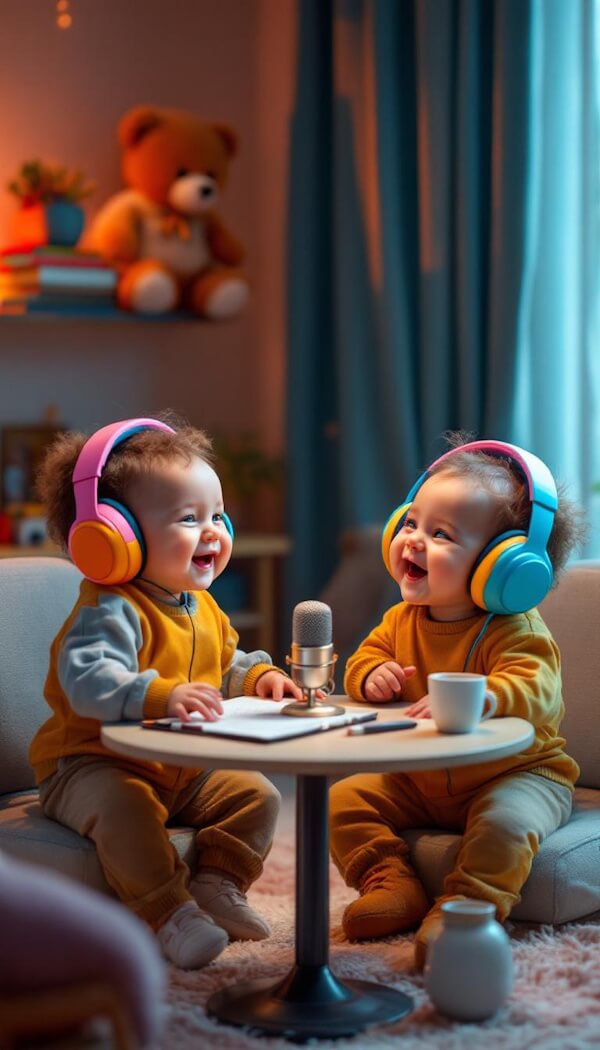
AI baby podcasts are short, podcast-style videos featuring fictional baby characters that appear to speak, tell jokes, answer questions, or explain a topic. They often use an AI-generated voice, facial animation, lip-syncing, and a short script.
These videos are different from audio podcasts made for babies or young children. An AI baby podcast is usually designed for social media, especially TikTok, Instagram Reels, and YouTube Shorts.
The format works because it creates an instant contrast: a baby-like character delivers an adult-style opinion, product message, or funny observation. For brands and creators, the goal is not just to make people laugh. It is to use a clear hook, a simple story, and a memorable message in a short video.
In this guide, you will learn how AI baby podcast videos work, how to create one responsibly, and how to use the format for brand storytelling and short-form content.
Example of an AI-generated baby podcast video using a fictional character.
What Is an AI Baby Podcast?
An AI baby podcast is a short video where a fictional baby character appears to host a podcast or interview. The character may share a joke, a product opinion, a quick tip, or a playful “hot take.”
Most creators use four pieces to make the video:
- A character image: A fictional baby character created with AI or used with clear permission.
- A short script: Usually 15 to 45 seconds, with one main idea.
- An AI voice: A voice that matches the character and tone.
- Facial animation and lip-syncing: Technology that makes the character appear to speak.
For a wider look at how AI can help creators plan, produce, and publish video content, read AI for YouTube: Redefining Content Creation.
How to Create an AI Baby Podcast Video
The best AI baby podcast videos are short, simple, and built around one clear idea. Do not try to explain your entire business in one clip. Focus on one problem, one joke, one product benefit, or one quick story.
- Create an original character. Use a wholly fictional AI-generated character whenever possible. Do not use a real child’s image or voice without clear written permission.
- Write a 15 to 45 second script. Start with a strong opening line. Give the character one main point, then end with a simple call to action.
- Create the voice and animation. Use an AI talking-character tool to add voice, facial movement, and lip-syncing.
- Edit for vertical video. Use a 9:16 format for TikTok, Instagram Reels, and YouTube Shorts. Add captions because many people watch with the sound off.
- Test different openings. Try two or three versions of the first line. The opening strongly affects whether people keep watching.
If you need help writing a stronger opening, use these video hooks for YouTube Shorts, Reels, and TikTok. For more help planning a short script, see How to Generate Engaging Short-Form Video Script Ideas.
Before publishing, check that your video has clear captions, an easy-to-see character, and one message your audience can understand quickly. These video marketing do’s and don’ts can help you avoid common mistakes.
AI Baby Podcast Prompt Examples
Use these prompts as starting points for a short script. Keep the humor light, avoid sensitive topics, and make sure the joke supports the message.
Prompt for a Small Business Marketing Tip
Write a 30-second script for an AI baby podcast video. The fictional baby host gives small business owners one simple tip for improving their social media posts. Start with a funny hook. Keep the language clear and friendly. End with one practical action the viewer can take today.
Prompt for a Product Launch
Write a 20-second AI baby podcast script about a new product launch. The fictional baby host should explain one benefit in a playful way. Use one joke, one clear product detail, and a short call to action. Do not make exaggerated claims.
Prompt for a Brand Story
Write a 30-second AI baby podcast script that tells the origin story of a small business. The fictional baby host should explain the problem the business solves and why the owner started it. Keep the tone warm, simple, and memorable.
How Brands Can Use AI Baby Podcast Videos
This format works best when the message is simple. A fictional baby host can add humor and surprise, but the product, service, or brand idea still needs to be clear.
- Product introductions: Explain one product benefit in a quick, memorable way.
- Brand stories: Share why the business started or what problem it solves.
- Social media series: Create recurring clips around tips, customer questions, or common industry myths.
- Short-form ads: Test the format as a creative concept for a short paid or organic video.
- Behind-the-scenes content: Use the character to introduce a new service, event, or promotion.
A baby podcast video should support your larger video plan, not replace it. Start with one short clip, then turn the idea into other formats. You can learn more in Video Marketing 101: Tips for Small Business Owners.
For YouTube Shorts, choose a clear image that fits the video topic. This guide to choosing a YouTube Shorts thumbnail can help you make each post easier to recognize. Once you find an idea that works, turn it into multiple posts. Learn how to repurpose video content into optimized clips for more platforms.
Safety, Disclosure, and Usage Rights
Use a fictional AI-generated baby character whenever possible. If you use a real child’s image or voice, get written permission from the parent or guardian before creating or publishing the video.
Be transparent when a video uses AI. A simple note in the caption, such as “AI-generated character” or “synthetic voice,” can help viewers understand the format. If the post is sponsored or part of a paid campaign, follow the platform’s advertising and disclosure rules.
If a post is sponsored, includes an affiliate link, or features a paid partnership, use a clear disclosure that viewers can easily notice. The FTC’s Disclosures 101 guide for social media influencers explains how to make paid relationships clear to viewers.
Avoid using AI baby characters to promote restricted products, make health or financial claims, or create humor that could make viewers uncomfortable. Keep the concept playful, clear, and on-brand.
FAQ: AI Baby Podcast Videos
What is an “AI baby podcast,” exactly?
It’s a short-form podcast-style video featuring an AI-generated baby character (voice, face, animation, or all three) that tells a story, explains a product, or runs a funny bit that feels like a podcast clip. Most of the time, it’s not a real baby speaking; it’s a created character that looks and sounds like one.
Why are brands using AI baby podcasters for marketing?
Because it’s a fast way to earn attention. The format is familiar (podcast clip), the hook is instant (a baby “talking like an adult”), and the tone can stay light even when the topic is boring.
A simple example: a “baby host” doing a 30-second rant about why your new cold brew “hits harder than nap time.”
What kinds of brand messages work best with this format?
Anything that can be explained in one sharp idea. This style does best when the point is clear and the joke doesn’t get in the way. Good fits include:
- Product one-liners (what it is, why it matters, who it’s for)
- Brand stories (origin, mission, “why we made this”)
- Launch teasers (new flavor, new drop, new feature)
- “Hot take” bits that lead into a real benefit (keep it playful, not mean)
If it needs a three-minute legal disclaimer, it’s probably not the right format.
Do we need to disclose that the baby host is AI?
Use a simple disclosure in the caption, such as “AI-generated character” or “synthetic voice,” especially when the video could be mistaken for real footage.
Is it safe (and legal) to use a baby’s likeness or voice?
Using AI that copies a real child’s face or voice can create a serious risk, even if you found the clip online. Rights of publicity, privacy laws, and consent issues can arise quickly. Safer options:
- Use a wholly original, AI-generated character that isn’t based on a real child.
- Avoid training or prompting the model to mimic a specific person.
- Get written permission if a real person’s likeness is involved (and be extra careful with minors).
If the joke is “this looks like my friend’s kid,” that’s your sign to stop. This is general information, not legal advice. Check the relevant laws, platform rules, and licensing terms before publishing a campaign.
Who owns the content, and can we use it in ads?
Ownership depends on your production setup and the tools used. In general, brands should lock down two things:
- Usage rights: where you can post (organic, paid ads, TV, OOH, website).
- Licensing terms for any AI tools, voices, music, fonts, or templates.
If you’re working with a creator or agency, make sure the contract says you can run the videos as paid ads, and for how long.
How do you keep an AI baby podcast on-brand (and not cringe)?
Give the “baby host” a real role, not just a random voice. Decide what the character is allowed to be, and what it’s not. A quick, workable checklist:
- Voice: sweet, sarcastic, curious, bold, calm (pick one)
- Word choices: 5 to 10 on-brand phrases, and 5 banned ones
- Boundaries: no insults, no sensitive topics, no “adult baby” weirdness
- Punchline rule: the joke supports the product, it doesn’t replace it
If your brand is premium, keep the humor clever, not chaotic.
Can AI baby podcasters handle storytelling, not just jokes?
Yes, and that’s where it gets fun. You can use a mini-arc that fits in 20-45 seconds. One clean structure:
- Problem: “My nap got ruined by bad coffee.”
- Discovery: “Then I tried this cold brew.”
- Proof: one specific detail (taste note, ingredient, feature)
- Close: a short call to action that fits the character
Story first, baby second.
What should we avoid so it doesn’t get flagged or backfire?
A few common mistakes can turn a funny clip into a comment-section disaster. Watch out for:
- Making it look like a real baby endorses something (primarily restricted products)
- Sexualized jokes, harsh language, or anything that feels exploitative
- Misleading claims (health, money, “guaranteed results”)
- Using a real child’s image or voice without explicit permission
- Humor that targets protected groups or real people
If you wouldn’t want it quoted back to you in a meeting, don’t ship it.
How do we measure whether these videos actually work?
Treat it like any short-form creative test. Track performance by goal, not vibes. Common signals to watch:
- Hook rate (how many people stay past the first 2 to 3 seconds)
- Watch time and replays (a strong sign the joke landed)
- Clicks or profile visits (if it’s meant to drive action)
- Comments quality (are people repeating your product line, or just saying “creepy”)
If people only talk about the baby, the brand message didn’t stick.
Final Thoughts
AI baby podcasts are a playful short-form video format that can help a brand earn attention, explain one idea, and create content people want to share. The most effective videos keep the script short, the character original, and the message clear.
Start with one simple idea, test a few different hooks, and create a video that fits your brand voice. Then reuse the best concept as a YouTube Short, Instagram Reel, TikTok, or part of a wider content campaign.
Need Help Creating Short-Form Video Content?
Originally published December 29, 2025; Republished September 5, 2026, to update content.

As a Visual Digital Marketing Specialist for New Horizons 123, Julie works to grow small businesses, increasing their online visibility by leveraging the latest in internet and video technologies. She specializes in creative camera-less animated video production, custom images, content writing, and SlideShare presentations. Julie also manages content, blog management, email marketing, marketing automation, and social media for her clients.



0 Comments