
Ever heard of GEO? If not, you’re not alone. Generative Engine Optimization combines traditional SEO with the evolving capabilities of AI-driven search engines.
Instead of just aiming for Google’s old-school algorithms, GEO focuses on how AI like ChatGPT and Bing Chat deliver results and pull from content.
In short, it helps your content get found by both users and smarter engines. Why should you care? GEO is transforming online visibility and may soon disrupt your digital strategy.
If you want your content to stay findable and ahead of the curve, wrapping your head around GEO is a smart move. How can this help boost your site’s search presence and keep you one step ahead of your competition?
What is Generative Engine Optimization (GEO)?
If you’re hearing whispers about GEO, you’re not alone. It sounds techy, but it’s much more than a buzzword.
GEO stands for Generative Engine Optimization, a fresh twist on the old SEO game. Instead of optimizing web pages solely for keyword-hungry bots, GEO tailors your content to intelligent, AI-powered engines that operate and think differently from traditional search systems.
With platforms like Bing Chat and Google’s AI features changing how info gets delivered, the way your content is found has shifted.
GEO is about tuning your content for these AI systems. They draw answers and ideas from numerous sources, and the rules they employ differ from those used in traditional algorithms. So, what sets GEO apart? Let’s break it down.
GEO vs. Traditional SEO
Traditional SEO is like training for a spelling bee, where the rules never change: use keywords, get backlinks, tidy up meta tags, and you stand a good chance.
GEO is more like prepping for a fast-paced trivia contest with a smart robot host. The basics still help, but that robot is looking for more context, intent, and structured info than ever before.
Here’s how GEO pushes beyond regular SEO:
- Context Matters More: AI engines dig for meaning, not just keywords. GEO content speaks in clear, human-like language. It answers questions people ask, sometimes even anticipating follow-ups.
- Results Aren’t Just Links: Generative engines synthesize answers by pulling together pieces from all over the web. Your content needs to be clear and quotable, ready to appear in snippets and AI replies.
- Structure Counts: Clean formatting helps AI engines “understand” your info. Bullet points, headings, and concise phrasing make it easy for the AI to select, reshape, and present your answers.
- Originality and Freshness: AI search draws from up-to-date, authoritative sources. GEO is about keeping your info original, adding expert perspectives or data that the AI can’t find elsewhere.

Wondering how this all ties to the leaps AI is making? GEO is deeply connected to recent advances in artificial intelligence, especially tools built to make businesses smarter and more efficient. For more on where AI can take you, check out these AI Solutions for Business Growth.
How GEO Works with AI-Driven Engines
GEO is engineered for tools that “think” and talk back, not just deliver a pile of links. Consider modern AI search platforms.
When someone asks, “What’s the fastest way to improve my business efficiency?” an AI engine doesn’t just find a webpage. It pieces together a conversational reply from various trusted sources, maybe pulling from your blog post, a competitor’s data, and a government report—all in one go.
If your content isn’t primed for GEO, there’s a good chance the AI skips right over it or pulls in a competitor’s soundbite instead. Here’s why structuring for GEO pays off:
- Better Snippet Potential: The more clear and structured your info, the more likely it is to appear in featured snippets or become the “voice” of an AI reply.
- Broader Reach: AI-driven engines aren’t just on web browsers. They power chatbots, smart speakers, and business tools. With GEO, your content can appear wherever people or bots are searching for answers.
- Business Insights: GEO ties directly into AI-driven search solutions that are transforming how people and businesses find answers online.
If you want to explore real tools already using this approach, see the range of AI productivity tools in 2025, helping people work smarter, not harder.
The Purpose Behind Generative Engine Optimization
Why bother with GEO? The answer is as simple as “show up where your audience is.” More users now interact with AI-driven engines instead of browsing page after page of blue links.
GEO helps you adapt so your content is seen, summarized, and shared by these new engines.
- Stay ahead as search engines get smarter.
- Reach users who want fast, trustworthy answers—not just “ten blue links.”
- Enhance your content’s quotability for AI summaries, chat responses, and business tool suggestions.
- Empower your business to benefit from the AI revolution. Curious about the possibilities? See how companies put AI-enabled business strategies into action.
In a nutshell, GEO makes your content speak the language of both people and machines, boosting your reach in a search world that’s getting smarter by the day.
Why GEO Is Essential in Today’s Search Ecosystem
The search world is no longer what it used to be. Search engines are shifting toward AI that thinks more like a person, less like a rulebook.
With the rise of generative AI, engines can now read, understand, and piece together responses in ways we never saw coming. If you want your content to capture attention, GEO needs to be a part of your playbook. It’s not just about being found; it’s about being chosen and featured by AI-powered search. Let’s explore why this new approach is a must.
The Relationship Between GEO and Traditional SEO
Traditional SEO is like laying down railroad tracks. You pick your route with keywords and links, and the search engine follows your map. But with GEO, the train drives itself and can choose new routes based on context, intent, and user needs.
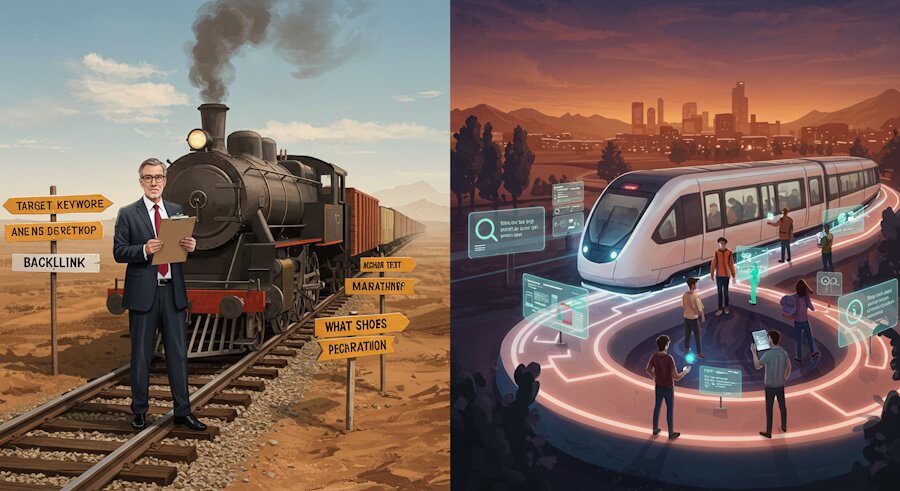
Here’s what’s changing:
- Old SEO: You optimize for rankings with targeted keywords, meta data, backlinks, and technical fixes.
- GEO: You optimize for AI comprehension by structuring information in a way that machines can spin into natural replies.
Consider how Customized SEO Solutions have always focused on tailored strategies for Google’s ranking factors. GEO, though, adds another layer: making your content “answer-friendly” for AI engines.
You need to consider how an AI like ChatGPT would utilize your content to generate its responses.
What’s fueling all these changes? Generative AI is taking center stage in search. If you still doubt the scale, see how Google is rolling out Generative AI in Search. The search box now resembles a conversation, and people expect comprehensive answers, not just links.
With GEO, you don’t just target search bots. You prioritize:
- Content that’s clear, conversational, and structured.
- Answers that can be copy-pasted or quoted in AI summaries.
- A focus on what makes your solution unique, so the AI picks your content out of the pack.
How GEO Impacts Content Strategy, Ranking, and Visibility
GEO is shaking up how we plan content and obsess over rankings. If you’re used to writing for humans and sprinkling in keywords for bots, you now need content that stands out to smart engines that synthesize, summarize, and present.
GEO impacts your strategy in several ways, including:
- Keyword Usage: Keywords still matter, but now you add context and related terms. AI prefers rich, natural language. Say goodbye to robotic keyword stuffing.
- Content Creation: GEO rewards well-organized, direct answers. Think of your writing as “AI fuel.” Use FAQ formats, lists, tables, and summary boxes to help AI extract value and share it forward.
- Brand Authority: When an AI engine regularly pulls your content into answers, your brand earns credibility and exposure. It’s like having your own expert quoted on TV, except the audience is every single searcher.
If you want proof that AI-driven content can help with reach and authority, look at examples like AI Generated Images. Using AI to enhance posts isn’t just trendy. It catches AI engines’ eyes, boosts engagement, and sets you apart from generic competitors.
Below are practical ways GEO changes the game:
- Make your answers skimmable and ready for direct use.
- Add visuals enhanced by AI to make your posts stand out. Modern engines use Visual AI Technologies to index and understand images, so don’t just focus on text.
- Tap into vision tech like Vision AI: Image and visual AI tools to add image recognition power to your site, making your content discoverable in new ways.
Let’s face it. Businesses can’t afford to sit back and wait. Search engines are changing, users expect quick answers, and brands that skip GEO will miss out. Investing in GEO now means you’re laying the groundwork for visibility in the next era of search, not just clinging to what worked last year.
How to Start Optimizing for Generative Engine Optimization: Practical Steps
Ready to take GEO from buzzword to results? Start by focusing on what matters most to AI-driven engines: clarity, proper structure, and content that the bots want to pull and present.
You don’t need a computer science degree, but you do need a smart action plan. Here’s how to roll up your sleeves and make your content geo-friendly from day one.
Choose the Right Content Formats
AI-powered engines love content that’s easy to quote, summarize, or repurpose. Think beyond simple blog posts. If your content is disorganized, it’s like building a LEGO set without instructions—expect chaos! Opt for these standout formats:
- FAQs: Short, Q&A-style blocks make information easy to grasp.
- Bullet Lists: Quick to read, quick for AI to repackage.
- Tables: Crystal clear comparison data or processes.
- Short Paragraphs: No fluff, just the facts.
- Visuals: Images, infographics, and even simple diagrams get attention.
Want more on using images, videos, and infographics? Check out these Visual Content Strategy Tips for a blueprint on maximizing different formats.

Apply Technical Best Practices
It’s not all about the words you use; it’s also about how your website serves them up. Minor technical tweaks can help AI engines “read” your pages smarter.
Below is a checklist to keep your content fully optimized for GEO:
- Use descriptive headlines, not just keyword phrases.
- Break up big blocks of text with subheadings.
- Add schema markup (like FAQ or HowTo) when relevant, so search engines “see” the purpose of your sections.
- Compress images so your pages load quickly.
- Make sure your site is mobile-friendly. (Nobody scrolls sideways on their phone for fun.)
- Use alt text on all visuals to describe what they show in plain language.
These details help generative engines quickly recognize what your page is about. You’re basically giving them a neon sign: “Pick me for your answer!”
Focus on Ongoing Analysis
Getting GEO right isn’t a one-and-done move. Generative engines evolve, so it’s essential to test and adjust your content continually.
Stay on top with a repeatable process:
- Track which of your pages appear in AI-generated responses or featured snippets.
- Monitor your traffic sources to identify if chat-based engines or voice assistants are sending new visitors.
- Regularly update your top posts with fresh stats, new tips, and relevant media.
- Use feedback tools or audience polls to ask readers how useful your AI-answered content really is.
For more proven tactics that can help you repackage your existing posts (giving them new life with generative engines), dive into Boost Your Blog SEO Rankings. It’s packed with practical advice on optimizing, updating, and promoting for stronger search and GEO reach.
Bonus: Blend GEO with Traditional SEO
You don’t need to throw out old SEO habits. Keep your classic strategies alive, but tweak them for today’s bots:
- Use natural keywords and phrase variations within answers.
- Link out to credible sources (both internal and external) to establish trust.
- Repurpose long-form content into snackable pieces AI loves.
Pairing GEO and traditional SEO lets you keep a foot in both worlds—serving both the old-school bots and new generative engines.
With these practical steps, optimizing for GEO is less about rocket science and more about smart, steady tweaks. After all, search engines may be getting smarter, but your content can always stay one step ahead.
Frequently Asked Questions (FAQ) about GEO
What is Generative Engine Optimization (GEO)?
Generative Engine Optimization is the practice of creating content that is easily understood by AI-driven search engines, enabling them to summarize and accurately quote it. Unlike traditional SEO, GEO focuses on how AI engines, such as ChatGPT or Bing Chat, retrieve, process, and present information to users.
How is GEO different from traditional SEO?
Traditional SEO focuses on targeting keywords and improving search engine rankings. GEO goes a step further by structuring content in clear, concise formats—such as bullet points, FAQs, and tables—that AI engines can utilize in summaries, chat responses, and featured snippets.
Why is GEO important now?
AI-driven search is replacing pages of simple links with direct answers, summaries, and conversational replies. If your content isn’t optimized for GEO, it may be skipped or misrepresented by these new engines.
What types of content work best for GEO?
Well-structured content that uses natural language and offers direct answers is ideal. FAQs, lists, tables, and short paragraphs make it easier for AI to find and quote your content.
Do keywords still matter for GEO?
Yes, but context is more important. Use keywords naturally within your answers and provide additional context so that AI can understand the entire meaning, not just individual terms.
How can I measure if my GEO strategy is working?
Track if your content appears in AI-generated answers, chatbots, or snippets. Monitor incoming traffic from AI-related sources and update your top content regularly to stay relevant.
Do I need to overhaul my entire SEO strategy for geo-targeting?
No, adapt it. Combine classic SEO practices with geo-targeted techniques, such as optimized structure, natural phrasing, and concise answers, to appeal to both traditional and generative search engines.
Can visuals and images help with GEO?
Yes. AI-powered engines now recognize and use images, infographics, and diagrams. Use proper alt text and clear visuals to help AI understand and index your content.
How often should I update GEO-optimized content?
Review and update important posts every few months, or when you notice changes in AI-driven search results. Fresh, authoritative content is more likely to be featured by generative engines.
Final Thoughts About GEO
GEO continues to rise in importance as AI search becomes smarter and more prevalent. Ignoring this trend puts your content at the back of the line, while the competition gets quoted and cited by AI engines.
Now’s the time to rework your approach so both people and AI-powered tools want what you must share.
Start making GEO a core part of your digital marketing strategy. Analyze your content, keep it structured, and let clarity lead the way. For ideas on staying ahead and using AI to strengthen your business, check out Redefining Success with AI Insights.
Thanks for reading! What strategies will you try first, and where do you think GEO will take your content next? Share your thoughts and let’s keep the conversation going.
Originally published June 30, 2025; Republished November 26, 2025, to update content and add video.

Enhance and Refine Your AI Image Prompts

As a Visual Digital Marketing Specialist for New Horizons 123, Julie works to grow small businesses, increasing their online visibility by leveraging the latest in internet and video technologies. She specializes in creative camera-less animated video production, custom images, content writing, and SlideShare presentations. Julie also manages content, blog management, email marketing, marketing automation, and social media for her clients.



0 Comments